

Year 2022 was grand for Kolkata from the celebration point of view as the joy doubled with the announcement of UNESCO’s intangible cultural heritage of humanity list. As the list was announced in December 2021 and the Durga Puja of 2021 was already over so the celebration was done this year to mark the inscription. Post covid this year the festival was again a grand affair.
Bengalis have plethora of festivals but Durga Puja is the grandest of all. Durga Puja is celebrated in autumn (September or October) to mark the victory of Goddess Durga over the demon Mahishasura. This puja has another angle also, it is believed that Lord Rama first conducted this puja in autumn as he was advised by Lord Brahma to do so in order to kill Ravana. Not only that it is also believed that Goddess Durga comes down from mount Kailasha to earth to her parents place, so her homecoming is celebrated as Durga Puja.
Bengalis celebrate this festival with great zeal. They plan throughout the year about how to celebrate the puja in the best way, they shop, binge eat and most important of all wherever they are they are they fly back to their home so as to celebrate it with their family.
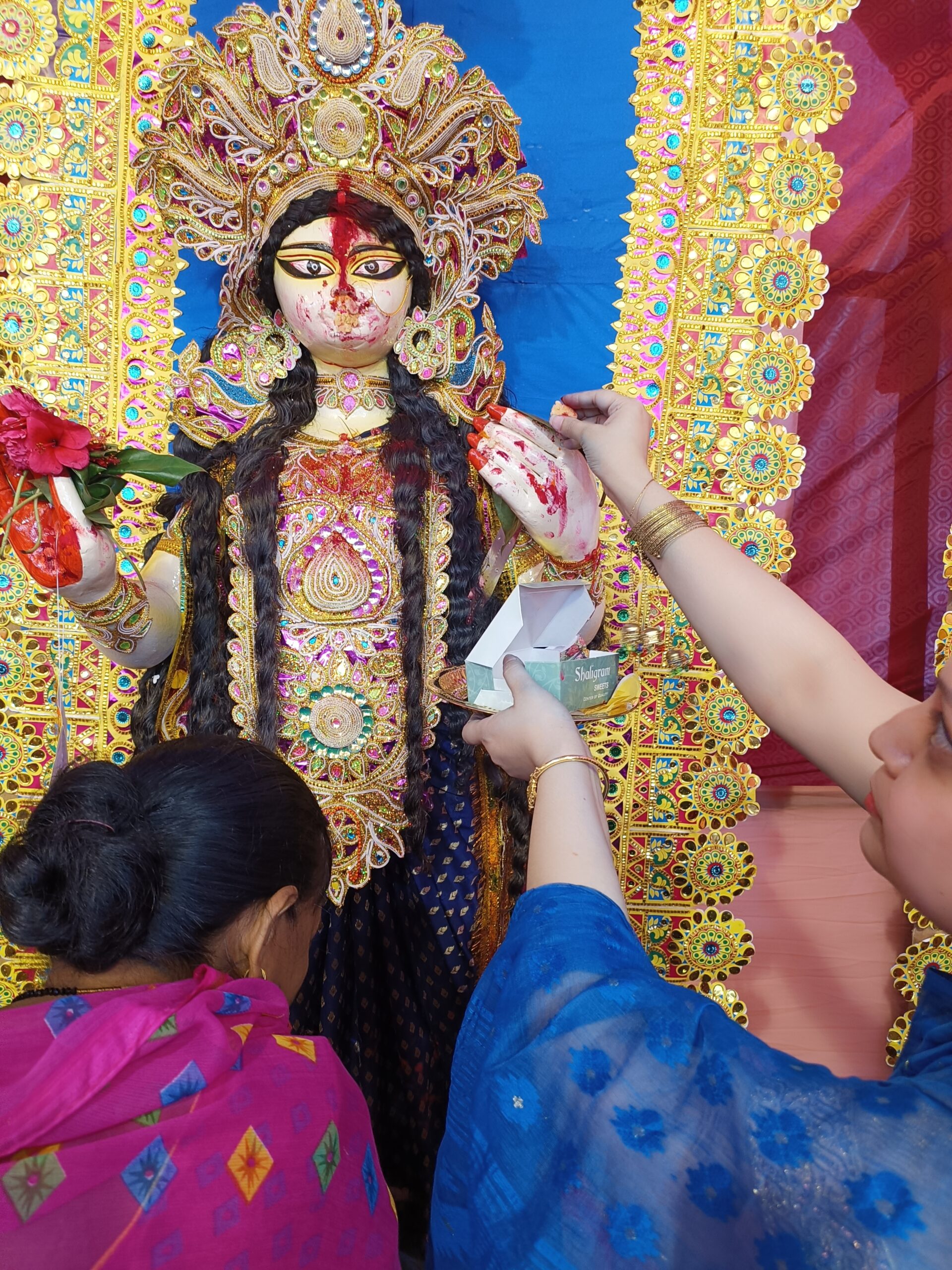
This is basically a ten days affair but the main rituals of the puja starts with “Bodhon” on Sasthi then followed by “Kola bou snana” (bathing the banana plant which is worshipped as Lord Ganesha’s bride) on the seventh day i.e. Saptami. On Astami, young girls (kumaris) are worshipped as goddess Durga, after that a ritual called “sandhi puja” is performed by lighting 108 earthen lamps. This ritual is performed during the transition period i.e. Astami to Navami. It is believed that it’s mentioned in puranas that during this transitional phase goddess Durga transformed into Chamunda and defeated other two associates of Mahishasura, i.e. Sumbha Nishumbha. Navami is the day when people perform dhunochi naach. Coconut fibre or charcoal is placed in a clay pot and fire is put on. People hold these clay pots in hand and dance. On the last day of puja i.e. Dashami Goddess Durga is bid a grand goodbye by offering sweets and smearing vermillion in her face. It is celebrated as “Sindur Khela” where women smear vermillion on Goddess Durga and her family members and perform boron with beetel leaves, even on the last day of the puja the aparajita (butterfly pea) leaves are also offered. After that idols are taken out of pandals where the idols were worshipped and a grand procession takes place afterwards in order to escort Goddess Durga. The bitter moment of immersion takes place afterwards. The idols are immersed in nearby rivers, this ritual indicates her return to mount Kailash i.e. to her husband Lord Shiva’s abode.
The festival of Durga Puja in Kolkata has made it to the global map by joining the list of UNESCO’s intangible cultural heritage list as it is grandest celebration of homecoming.
According to Unesco, “Durga Puja is seen as the best instance of the public performance of religion and art, and as a thriving ground for collaborative artists and designers. During the event, the divide of class, religion and ethnicities collapse as crowds of spectator walk around to admire the installations”.
The person behind the hard work is Tapati Guha Thakurta, she is a renowned art historian. She along with her team prepared all the dossier which were sent by union cultural ministry to UNESCO in the year 2019. Sandipan Mitra, Devi Chakrabarti and Nilanjan Bhattacharya also worked on the dossier. It is believed that in coming years there would be boost in the economy which flourishes and develop around this festival.